


iNN Studio #03


Specs
- 65%
- 6.25U Single blocker WK
- 7U Dual blockers WKL
- Actual Front Height=17.47 mm
- EKH (Effective Keystroke Height) =21.8
- Typing Angle:7°
- With Alu Internal Weight, ≈ 1.1kg
- With Copper Internal Weight, ≈ 1.7kg
- 1.6mm, FR4, White matte finish, White Sockets, Copper-filled logo and edge, No flex-cut, QMK/Vial, Wired only
- JST to USB-C Daughter Board
- Hontoo, Shenzhen, China


Sales Info
Entry kit
- 1 × Alu top case
- 1 × PC bottom case - Fractal Glass
- 1 × Alu Internal weight
- 1 × Alu badge
- 1 × Solder PCB
- 1 × Alu plate
- 1 × Solder PCB
- 1 × Alu full plate
What else are included?
- 1 × Daughterboard + JST cable
- Sufficient D3 hollow silicone grommets (50A hardness)
- 1 × D3.5mm O-ring (50A hardness)
- Sufficient limiting pins & spacers
- Sufficient TOP mount silicone sleeves
- 16× Custom iNN feet (8 black + 8 white)
- All necessary screws + spares
- 1× PET bottom pad
- 1× iNN Studio custom keyboard carrying case
- 1× iNN Studio premium velvet bag
- 1× Exclusive PVC collector’s card
- All necessary accessory bags & protect
- Custom shipping carton packaging
Learn more about what's included by default
Vendor List:
TBA
- Global GB
- Limited time, Unlimited quantity
- 100
Entry :
- starting at just $220-250
#Note: Prices may fluctuate but remain within this range
- Global group-buy opens at 1th Feburary 2026
- CN group-buy has ended in 15th Sep 2025
Early Q3 2026
Anodized top case options:
Retro Greige / Ice Blue / Aloe
Silver / Black / Icy Berry / iNN Orange
Dyed PC bottom options:
Natural Clear / Coffee Brown / Ice Blue
Upgrade to:
- Hot-swap PCB
- PC bottom - Dynamic Ripple
- Copper badge
- Mirrored PVD SS badge
- Copper internal weight
- Solder PCB
- Hotswap PCB
- 1U accnet
- Daughterboard and JST cable
- Plate in Alu/PP/PEI/CF/PC
- PC bottom - Dynamic Ripple/Fractal Glass
- Copper/mirrored PVD SS badge
Compatibility
- Hotswap:
Split Backspace, Split L-Shift, Stepped Caps
6.25U single bloacker; 7U dual blocker
- Solder:
Split Backspace, Split L-Shift, Stepped Caps, ISO Enter
6.25U single bloacker; 7U dual blocker
*Drag to see full layout map

Solder

Hot-swap
Mounting Styles
iNN Multi-Sructure System
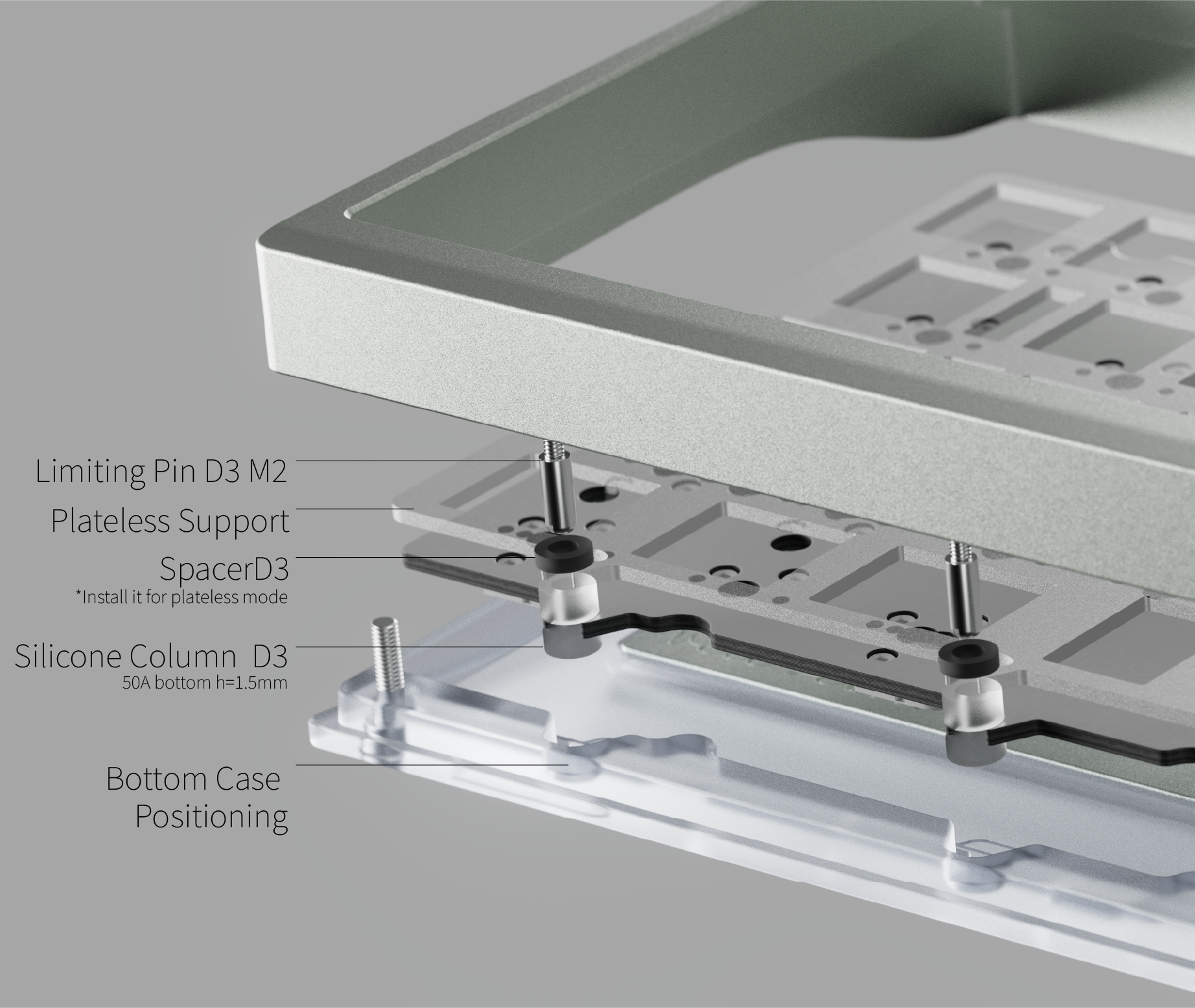
The internal assembly is suspended above the bottom case by the silicone columns, while limiting pins from the top case insert into the columns, restricting planar movement.
In this mode, the entire internal assembly makes no hard contact with the case. Simultaneously, the limiting pins introduce a subtle sense of firmness, giving a character best described as resilient.
With plateless mode and 3.7mm available travel space, the typing experience on the alphanumeric zone becomes notably soft and bouncy.
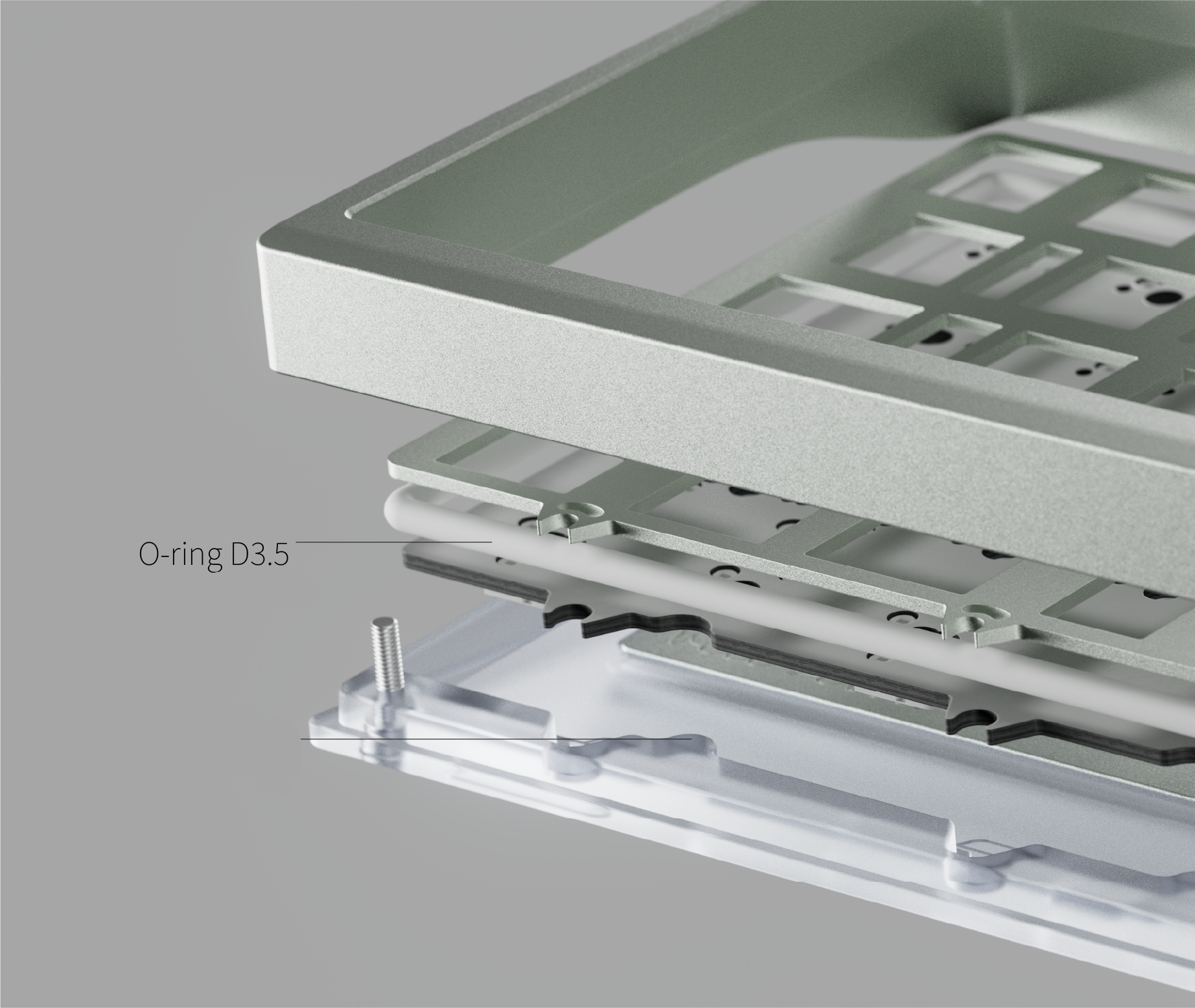
Katina TKL adopted a configuration of 5 upper and 3 lower O-ring bosses to support the internal assembly.
It also employs standard D3.5 silicone O-ring and includes compatible clearance cuts in the plate for screw-in stabilizers. This delivers a typing experience that is moderately soft and acoustically focused.
The design is compatible with most mod parts and accessories readily available on the market,
e.g. Nexuros X Geon ‘s PCB Snap & Key Snap
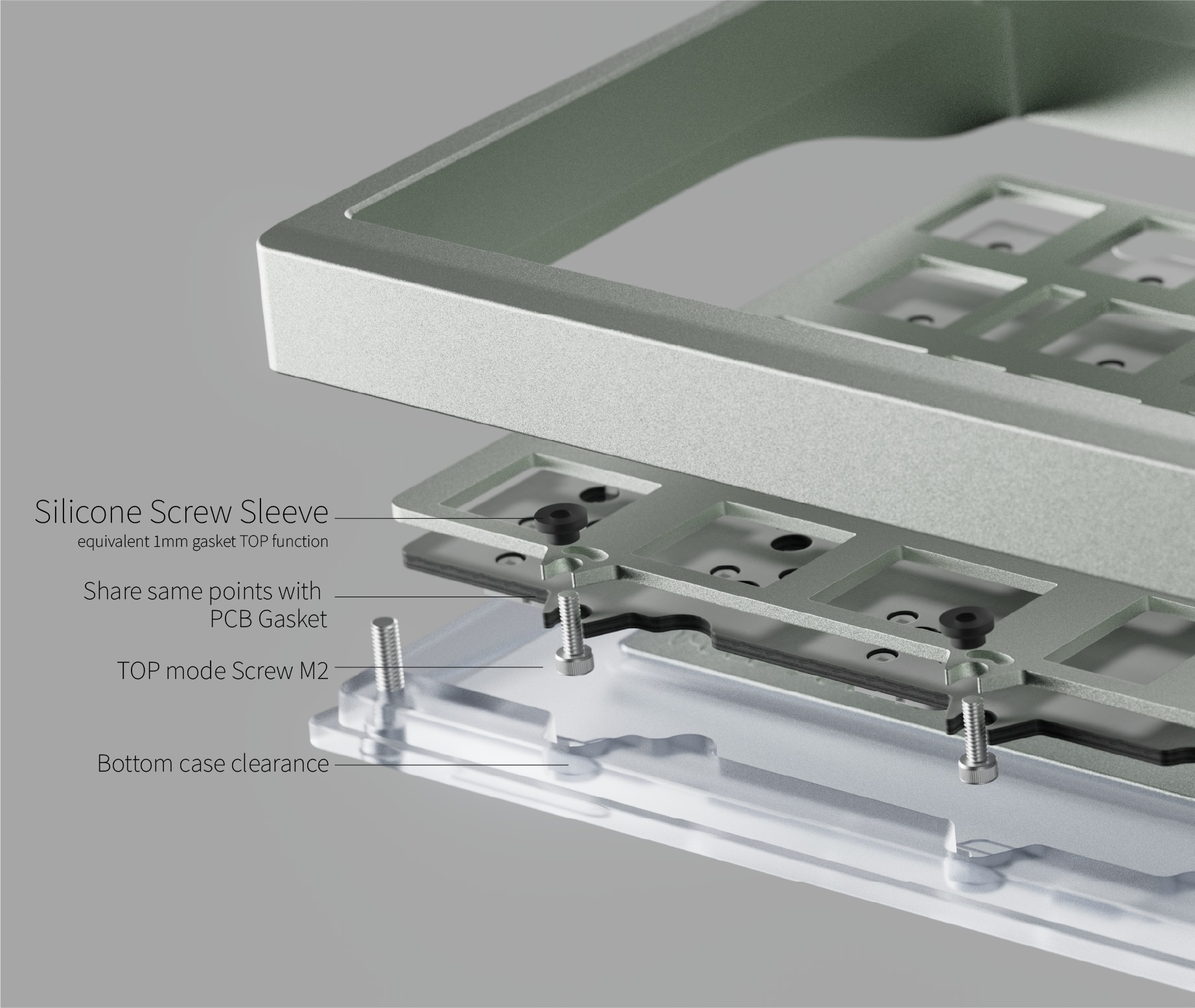
The Katina TKL can also be configured in a top-mounted mode using M2 cup head screws fitted with custom silicone sleeves.
The degree of screw tightness can be adjusted to influence the down travel to some extent, while the plate makes only minimal contact with the screw heads.
This design effectively isolates vibration and unwanted noise, resulting in a solid typing feedback.
Design Philosophy
Three-layers:
Top layer: Anodized aluminum upper case
Main body: Complete PC base
Core: Embedded metal weight
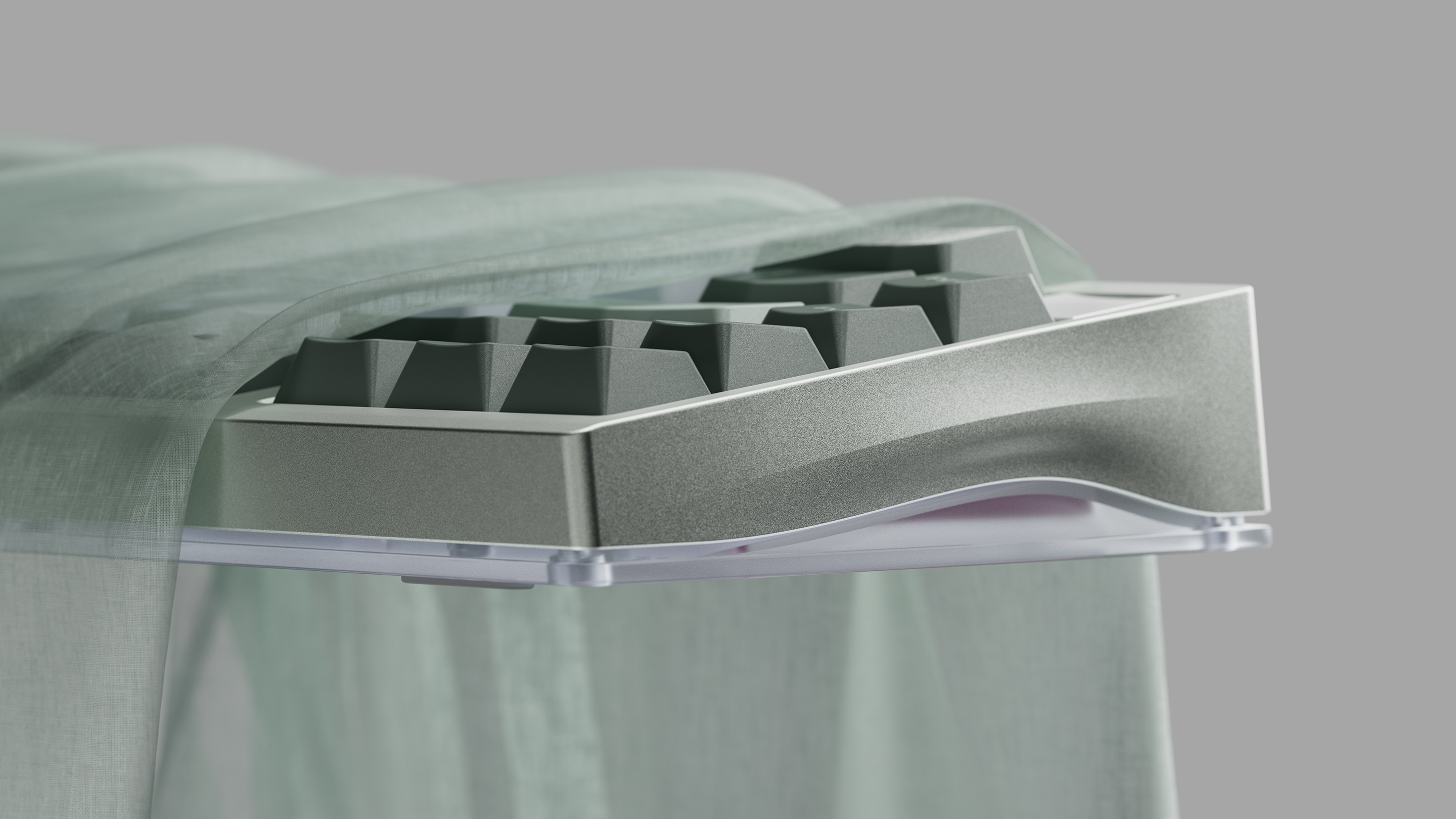
The form features a complete trapezoid without front/rear inward tapering - not a conservative choice, but rather to increase the side and bottom surface area, providing a stage for the PC material's light-transmitting variations while giving the keyboard a quiet, substantial texture.
Although PC dominates visually, the addition of the anodized aluminum upper case provides crucial support to the design:
- Precise contour definition: The metal upper case narrowly borders the PC shell like a picture frame, setting boundaries for the hazy beauty and avoiding visual looseness.
- Functional and aesthetic anchor point: It covers areas requiring clear structural transitions; otherwise the internal structure would be completely exposed, which from our aesthetic perspective would disrupt the keyboard's integrity and beauty. Meanwhile, the anodizing process creates a delicate textural contrast with the PC's matte surface, forming an interesting tension between the metal's sharpness and the PC's softness.
- Weight distribution: The added weight from the metal upper case gives the keyboard both the lightness of PC in hand while retaining the steadiness expected of a high-end tool.

On the sides of the upper case, we've outlined two curves with different curvatures. Using these curves as focal points, we created concave surfaces on the aluminum upper case that indent toward both top and bottom ends, refracting different light and shadow qualities from various angles to represent the wrinkles of a lifted veil. The PC base below connects to the upper case's inward-curving surface and extends outward again, continuing the undulating side design while adding stability when placed on a desk. The specially positioned internal weight sits just behind this protruding curved surface - its metallic luster and color shine through the PC surface of varying thickness, being thinnest and most transparent at the top, gradually dissolving into the thicker PC at the bottom. This creates subtle grayscale variations as light passes through the matte shell. The metal no longer straightforwardly displays craftsmanship, but becomes a dark undercurrent in the haze, requiring users to change angles to discover those hidden details. This ambiguous material relationship means the keyboard may offer new visual surprises with every use.

Looking at the bottom, at first glance it appears to be a completely flat PC base, but actually hides clever details. We embedded an oversized internal weight in the upper interior position, with its size and position finely adjusted to be visible through just 2mm of PC bottom surface. The two materials interpenetrate in three-dimensional space - the PC's misty light gently wraps the metal edges, while the metal skeleton reveals its solid presence at specific angles.
Additionally, we created several parallel, gradually vanishing curved textures inside the PC bottom case. By controlling the PC bottom thickness to be further reduced to 1.5mm at the thinnest points, we achieved unique lighting effects that create rippling veil-like folds at the bottom. When fingers touch the keyboard's bottom surface, the warm PC texture delivers a jade-like tactile sensation, while the 'just-right haze level' allows light to flow within, creating ever-changing visual effects. This delicate balance between revelation and concealment is an expressive method difficult for other materials to achieve.
Following our domestic IC phase, we've introduced an additional base texture option—'Dynamic Ripples'. This new pattern captures the delicate crumpling of layered veils, evoking concentric waves radiating across water's surface.The original parallel vanishing-line texture has been formally christened as 'Fractured Glass'
Three-layers:
Top layer: Anodized aluminum upper case
Main body: Complete PC base
Core: Embedded metal weight
The form features a complete trapezoid without front/rear inward tapering - not a conservative choice, but rather to increase the side and bottom surface area, providing a stage for the PC material's light-transmitting variations while giving the keyboard a quiet, substantial texture.
Although PC dominates visually, the addition of the anodized aluminum upper case provides crucial support to the design:
- Precise contour definition: The metal upper case narrowly borders the PC shell like a picture frame, setting boundaries for the hazy beauty and avoiding visual looseness.
- Functional and aesthetic anchor point: It covers areas requiring clear structural transitions; otherwise the internal structure would be completely exposed, which from our aesthetic perspective would disrupt the keyboard's integrity and beauty. Meanwhile, the anodizing process creates a delicate textural contrast with the PC's matte surface, forming an interesting tension between the metal's sharpness and the PC's softness.
- Weight distribution: The added weight from the metal upper case gives the keyboard both the lightness of PC in hand while retaining the steadiness expected of a high-end tool.
On the sides of the upper case, we've outlined two curves with different curvatures. Using these curves as focal points, we created concave surfaces on the aluminum upper case that indent toward both top and bottom ends, refracting different light and shadow qualities from various angles to represent the wrinkles of a lifted veil. The PC base below connects to the upper case's inward-curving surface and extends outward again, continuing the undulating side design while adding stability when placed on a desk. The specially positioned internal weight sits just behind this protruding curved surface - its metallic luster and color shine through the PC surface of varying thickness, being thinnest and most transparent at the top, gradually dissolving into the thicker PC at the bottom. This creates subtle grayscale variations as light passes through the matte shell. The metal no longer straightforwardly displays craftsmanship, but becomes a dark undercurrent in the haze, requiring users to change angles to discover those hidden details. This ambiguous material relationship means the keyboard may offer new visual surprises with every use.
Looking at the bottom, at first glance it appears to be a completely flat PC base, but actually hides clever details. We embedded an oversized internal weight in the upper interior position, with its size and position finely adjusted to be visible through just 2mm of PC bottom surface. The two materials interpenetrate in three-dimensional space - the PC's misty light gently wraps the metal edges, while the metal skeleton reveals its solid presence at specific angles.
Additionally, we created several parallel, gradually vanishing curved textures inside the PC bottom case. By controlling the PC bottom thickness to be further reduced to 1.5mm at the thinnest points, we achieved unique lighting effects that create rippling veil-like folds at the bottom. When fingers touch the keyboard's bottom surface, the warm PC texture delivers a jade-like tactile sensation, while the 'just-right haze level' allows light to flow within, creating ever-changing visual effects. This delicate balance between revelation and concealment is an expressive method difficult for other materials to achieve.
Following our domestic IC phase, we've introduced an additional base texture option—'Dynamic Ripples'. This new pattern captures the delicate crumpling of layered veils, evoking concentric waves radiating across water's surface.The original parallel vanishing-line texture has been formally christened as 'Fractured Glass'


Browse All Content by Creator